
Ointment Manufacturing Plant
Ointment Manufacturing Plant for Pharmaceutical Manufacturing
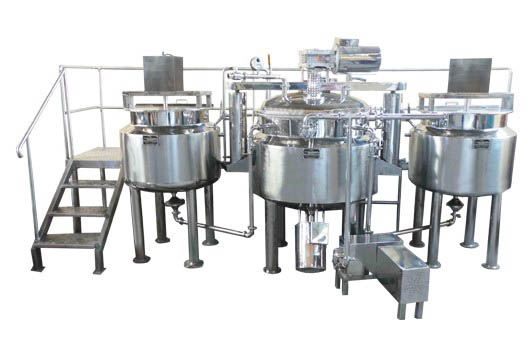
An Ointment Manufacturing Plant is a modern facility for producing semi-solid dosage forms like ointments, creams, and gels. It integrates equipment for handling, emulsifying, and blending oil/water phases with active ingredients. The plant prioritizes cleanliness with stainless steel, advanced filtration, automated cleaning, and strict environmental controls (HVAC), operating under rigorous quality control for consistency and compliance.
Key Features
- cGMP/FDA Compliance: Designed to meet stringent pharmaceutical and cosmetic industry regulations.
- Stainless Steel Construction (SS316L): Product contact parts are high-grade SS316L with a mirror, crevice-free finish for hygiene, corrosion resistance, and easy cleaning.
- Automated Control Systems: Features PLC/SCADA for precise process control, monitoring, and batch reporting.
- Integrated CIP/SIP: Automated Clean-in-Place and Sterilize-in-Place systems ensure thorough sanitation.
- High-Shear Homogenization: Essential for creating stable emulsions and achieving desired product texture.
- Vacuum System: Incorporated for de-aeration to prevent oxidation and improve product stability.
Technical Specifications
|
Parameter
|
Specification
|
|---|---|
|
Plant Capacity (Batch Size)
|
Customizable from 50 kg to 5000 kg per batch (e.g., 100 kg, 250 kg, 500 kg, 1000 kg, 2000 kg, 5000 kg)
|
|
Main Vessel Volume
|
Proportional to batch size (e.g., 120 L for 100 kg batch, 6000 L for 5000 kg batch), with ~20-30% headspace.
|
|
Material of Construction
|
Product Contact Parts: SS316L (medical grade stainless steel) <br> Non-Contact Parts: SS304
|
|
Surface Finish (Contact Parts)
|
Internal: Ra
le 0.4 $\mu$m (mirror polished); External: Ra
le 0.8 $\mu$m (matt/satin finish)
|
|
Design Pressure
|
Full Vacuum to +2.0 Bar (internal), 3.0-6.0 Bar (jacket)
|
|
Design Temperature
|
-5°C to +150°C (internal product), -5°C to +180°C (jacket)
|
|
Homogenizer Speed
|
Variable, typically 1500 RPM to 3000 RPM (adjustable via VFD)
|
Applications
Available Models
Hygiene & Safety
- Pharmaceutical Products: Manufacturing of topical medications such as antibiotic ointments, corticosteroid creams, analgesic gels, dermatological preparations, and transdermal patches.
- Cosmetic & Personal Care: Production of skin creams, lotions, moisturizers, sunscreens, hair gels, and other semi-solid cosmetic formulations.
- Nutraceuticals: Production of nutrient-rich creams or gels for topical application.
- Veterinary Products: Creation of ointments and creams for animal treatment.
- Specialty Chemicals: Manufacturing of various pastes or gels for industrial or specific applications requiring high purity and precise blending.
- Laboratory/Pilot Scale: Typically 5 kg to 50 kg batch capacity for R&D and small-scale production.
- Small Scale Production: Commonly 100 kg to 500 kg batch capacity.
- Medium Scale Production: Usually 500 kg to 2000 kg batch capacity.
- Large Scale Production: Typically 2000 kg to 5000 kg batch capacity or higher, custom-built.
- cGMP & Regulatory Compliance: Designed and constructed to meet stringent cGMP, FDA, WHO-GMP, and other relevant regulatory standards to ensure product quality and safety.
- SS316L Contact Parts: All surfaces coming into contact with the product are made of high-grade SS316L stainless steel with a mirror finish, preventing corrosion and facilitating easy cleaning.
- CIP/SIP Systems: Integrated Clean-in-Place (CIP) and Sterilize-in-Place (SIP) systems automate the cleaning and sterilization of vessels and pipelines, minimizing human intervention and ensuring high levels of hygiene.
- Closed System Design: The entire manufacturing process, from mixing to transfer, is typically enclosed to prevent environmental contamination and ensure product integrity.
- Vacuum De-aeration: Incorporates a vacuum system to remove air bubbles from the product, preventing oxidation, improving stability, and ensuring a smooth, uniform texture.
- Environmental Control: Critical processing and filling areas are often supported by HVAC systems that control temperature, humidity, and air purity (via HEPA filtration) to maintain cleanroom conditions.
- Interlocks & Safety Features: Equipped with safety interlocks, pressure relief valves, emergency stop buttons, and platforms/guardrails to ensure operator safety during operation and maintenance.
Schedule service today and let us take care of all your needs.
Our expert team is ready to provide prompt and reliable service, ensuring your machinery runs smoothly.